


Short answer: An API endpoint is a URL you call to request or send data. A webhook is a URL on your server that a third party calls when an event happens. Endpoints pull. Webhooks push. Both are HTTP URLs, which is why they get confused, but they flow in opposite directions.
If you're building software integrations, you've run into both of these terms. They get conflated often enough that it's worth being precise about what each one actually means and where the confusion comes from.
Webhook vs API endpoint at a glance
| Aspect | API Endpoint | Webhook |
|---|---|---|
| Direction | Client pulls from server | Server pushes to client |
| Trigger | Your code makes a request | An event in the source system |
| Who initiates | You (the consumer) | The third-party system |
| HTTP method | Usually GET, POST, PUT, DELETE | Almost always POST |
| Timing | On demand or scheduled polling | Real time, as events happen |
| Best for | Reads, writes, complex queries | Notifications, state changes, sync |
| Latency | Equal to polling interval | Milliseconds |
| Failure handling | Retry immediately with backoff | Depends on sender's retry policy |
| Setup on your side | API key, request code | A public URL that accepts POST |
| Resource cost | Higher when polling frequently | Low under normal conditions |
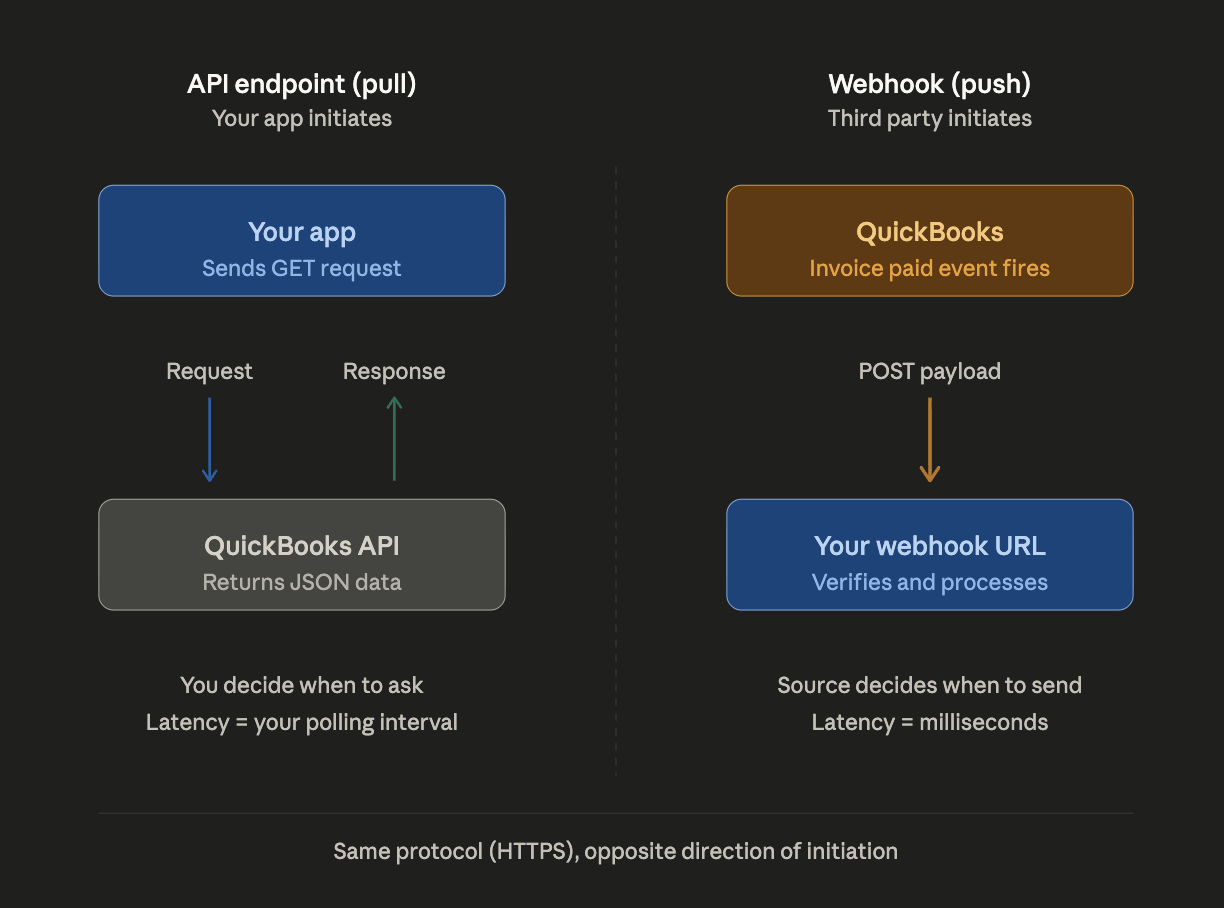
What an API endpoint is
An endpoint is a URL that exposes a resource through an API. When you make a request to https://api.apideck.com/accounting/invoices, that URL is the endpoint. It specifies the host, the API version (implied in the path or header), and the resource you want to interact with.
Endpoints are passive. They sit there and respond to requests. You call them; they answer. The client controls the timing: your code decides when to ask for data, and the API returns whatever matches the query at that moment.
A typical request to an endpoint looks like this:
curl -X GET "https://api.apideck.com/accounting/invoices" \
  -H "Authorization: Bearer YOUR_TOKEN" \
  -H "x-apideck-consumer-id: user_123" \
  -H "x-apideck-app-id: app_456"
The server responds with a JSON body containing the invoices that match the query, plus pagination cursors.
This model, often called polling when done on a schedule, is how most API integrations start out. Your app hits an endpoint every minute or every hour, fetches recent invoices, and processes the results. It works, but it has a cost: you're making requests even when nothing has changed, and you always have at least one polling interval of latency before you see new data.
What a webhook is
A webhook is a mechanism for pushing data from one system to another when something happens. Instead of your app asking for data, the source system sends it to you automatically.
Here's how it works in practice: you register a URL on your own server (your webhook endpoint) with the source system. Then you tell that system which events you care about, something like "notify me when an invoice is created" or "send me a payload when a payment is marked as received." From that point on, every time that event fires, the source system makes an HTTP POST request to your URL with the event data in the body.
A typical webhook payload arriving at your server looks something like this:
{
  "id": "evt_01HX8Y9N4ZQX8K7M2P3R5T6V8W",
  "type": "invoice.paid",
  "created_at": "2026-04-27T14:23:11Z",
  "data": {
    "invoice_id": "inv_8821",
    "amount": 4250.00,
    "currency": "USD",
    "customer_id": "cus_4419",
    "paid_at": "2026-04-27T14:23:09Z"
  },
  "service": "quickbooks",
  "consumer_id": "user_123"
}
Your handler receives this POST request, verifies the signature, looks up the invoice in your own database, and updates the status. No polling, no delay.
This is event-driven rather than request-driven. You're not pulling data on a schedule; the data comes to you the moment it's available.
Where the two terms overlap
The confusion usually comes from the fact that your webhook listener is technically an API endpoint. It's a URL that accepts HTTP requests. When a source system sends you a webhook, it's hitting your endpoint with a POST request. So "webhook endpoint" is a real phrase with a real meaning: it's the URL you registered to receive webhook payloads.
The distinction is about role and direction. An API endpoint is what you call to get or update data in a third-party system. A webhook endpoint is what that third-party system calls on your server when something changes.
A real-world example: invoice paid in QuickBooks
Let's walk through what actually happens when a customer marks an invoice as paid in QuickBooks, and how your app finds out.
With polling (API endpoints only):
- Your app runs a cron job every 5 minutes.
- It hits
GET /accounting/invoices?updated_since=2026-04-27T14:18:00Z. - QuickBooks returns the recently updated invoices, including the one just paid.
- Your app processes the change and updates your database.
- Total latency: up to 5 minutes. You also made 287 other requests today that returned nothing new.
With webhooks:
- The customer marks the invoice as paid in QuickBooks at 14:23:09.
- QuickBooks fires a webhook to your registered URL at 14:23:11.
- Your handler verifies the signature, processes the payload, updates your database.
- Total latency: 2 seconds. Zero wasted requests.
For something like revenue recognition or sending a thank-you email to the customer, those minutes matter. For a nightly accounting reconciliation, they don't. That is the whole decision.
Which one to use
For most accounting integrations, you want both.
Endpoints handle reads and writes. When a user connects their QuickBooks or Xero account to your product, you use API endpoints to fetch their chart of accounts, pull historical invoices, create new transactions, or reconcile payments. All of that is request-driven because you're the one initiating the operation.
Webhooks handle real-time sync. When an invoice gets paid in QuickBooks, you don't want to poll every minute hoping to catch it. You want to be notified immediately. QuickBooks fires a webhook to your listener, you process the payload, and your system updates without any delay.
The practical split: use endpoints when you're acting on data, use webhooks when you need to react to changes.
Webhook security: what most guides skip
A webhook endpoint is a public URL. Anyone who knows it can POST to it. Without verification, an attacker can forge events: fake invoice payments, fake refunds, fake user signups. Three things you need:
Signature verification. Every major webhook sender signs the payload with an HMAC using a shared secret. Stripe, GitHub, Shopify, QuickBooks all do this. Your handler recomputes the signature from the raw request body and the secret, then compares it to the header. If it doesn't match, you reject the request. Use the raw body bytes, not the parsed JSON, or you'll get false negatives from whitespace differences.
Replay protection. A valid signed payload captured by an attacker can be replayed. Include a timestamp in the signed payload and reject requests where the timestamp is more than a few minutes old. Most senders include this by default; check the timestamp.
IP allowlisting (when available). Some providers publish the IP ranges their webhooks come from. If yours does, restrict your endpoint to accept only from those ranges. This is belt and suspenders on top of signature verification, not a replacement.
For more on production-grade webhook handling, the Standard Webhooks spec codifies most of this if you're designing your own webhook system.
Reliability considerations
Webhooks introduce a delivery problem that polling doesn't have. If your server is down when a webhook fires, that event payload is gone unless the source system retries it. Most will retry a few times with backoff, but if your service has extended downtime, you can miss events.
This is why webhook-based integrations typically pair with a fallback polling strategy: webhooks keep you current under normal conditions, and a periodic full sync ensures nothing falls through during outages. Stripe's webhook documentation describes this pattern explicitly: subscribe to events for real-time updates, but also reconcile via the API on a schedule.
For accounting data in particular, missed events have real consequences. A payment update that doesn't sync means your revenue recognition is wrong, your reconciliation breaks, and someone in finance ends up chasing ghosts in a spreadsheet. Building retry logic and idempotency into your webhook handler is not optional. Understanding how to handle API errors and HTTP status codes is a prerequisite for any production webhook implementation.
Idempotency matters
One detail that trips up a lot of webhook implementations: you'll sometimes receive the same event more than once. Source systems retry on network failures, and it's not always clear whether your server received and processed the first attempt. A well-built webhook handler checks whether it has already processed a given event ID before doing anything with the payload. This is called idempotency: processing the same event twice produces the same result as processing it once.
The simplest implementation: store the event ID from the payload (the id field in the example above) in a table with a unique constraint. On every incoming webhook, try to insert the ID first. If the insert fails because the ID already exists, skip processing. If it succeeds, do the work.
For accounting integrations, where a duplicate invoice creation or a double-applied payment can create real accounting errors, idempotency in your webhook handler is non-negotiable.
What a unified API changes
When you're building integrations across multiple accounting platforms, managing webhooks per-platform adds real complexity. QuickBooks, Xero, Sage, and FreshBooks each have their own webhook schemas, different event names for the same underlying concept, different retry policies, and different verification mechanisms for confirming that a payload actually came from them.
A unified API layer normalizes this. Rather than wiring up separate webhook listeners for each platform, you subscribe once to a normalized event stream and receive consistent payloads regardless of which accounting system is on the other end. The same invoice.paid event format arrives whether the underlying system is QuickBooks or Xero, and your application logic doesn't have to know the difference.
That's the actual distinction. Endpoints are how you talk to external systems; webhooks are how those systems talk to you. Both are built on HTTP, which is why they look similar at first glance, but they serve opposite directions of data flow.
Ready to get started?
Scale your integration strategy and deliver the integrations your customers need in record time.


